Review velocity is the rate at which a business earns new reviews: how many arrive, how recently, and how steadily. It's usually measured over the last 30, 60 or 90 days, or as the time it took to earn your last five reviews.
Two businesses can both show 4.8 stars from 150 reviews. If one earned its last five reviews this fortnight and the other hasn't had a new one since spring, they look very different to customers and to Google. Review velocity is the number that tells them apart.
The three parts of review velocity
- Frequency: how often new reviews arrive. Ten a month says far more about a busy, trusted business than one a month.
- Recency: when your latest review was posted. Customers sort by "Newest", and a profile whose top review is eight months old looks closed, or worse.
- Consistency: whether reviews arrive steadily or in bursts. A steady flow looks natural. Twenty reviews in a week followed by silence looks like a campaign, and can trip Google's spam filters.
Review velocity vs review count vs star rating
| Signal | What it tells people | Weakness on its own |
|---|---|---|
| Star rating | How good you are, on average, across your whole history | A 5.0 from twelve reviews in 2022 says nothing about today |
| Review count | How established you are | 300 reviews, with none recently, suggests things have changed |
| Review velocity | How active and trusted you are right now | Needs a decent rating behind it to win clicks |
You need all three, but velocity is the one most businesses neglect, and the one you can change fastest. Your rating moves slowly once you have a lot of reviews (see how many reviews it takes to go up a star), while your velocity can change in a month.
Does review velocity affect Google rankings?
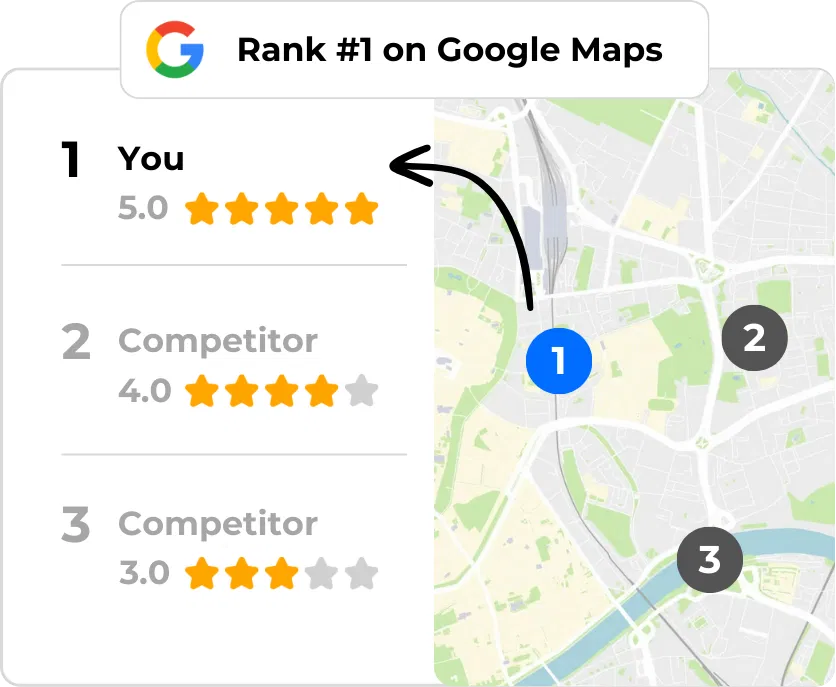
Google's own guidance says local results are based on three things: relevance, distance and prominence. Reviews feed into prominence. In Google's words, review count and review score factor into local search ranking, and more reviews and positive ratings can improve a business's local ranking.
Google doesn't publish exactly how it weighs recency, and nobody outside Google can tell you the precise formula. But the pattern local SEO specialists see again and again is consistent:
- Businesses that keep earning reviews tend to hold or climb their map pack positions.
- Businesses whose reviews dry up tend to slip, even with a high rating and a big total.
- Fresh reviews add fresh keywords. When customers mention "boiler service" or "emergency vet", those words can appear as highlighted snippets under your listing in search.
- AI answers in Google and Google Maps lean on recent reviews to describe businesses, so a stale profile gives them little to say about you.
The safe conclusion: a steady flow of genuine new reviews is one of the few local ranking signals you can influence every single week.
Why customers care about it even more
Customers judge recency instantly. Most people read the newest handful of reviews, not the all-time average. If the latest is from last year, they wonder whether you're still trading, whether the owner has changed, or whether something went wrong. If the latest five are from this month, they see a busy business that people are happy to vouch for.
How to measure your review velocity
There are three simple ways to put a number on it:
- Reviews per month: count the reviews from the last 90 days and divide by three.
- Days for your last five reviews: look at the dates of your five most recent reviews. Under 30 days is strong for most local businesses. Over 90 days is a warning sign.
- Compared with competitors: run the same check on the top three businesses in your local map pack. Velocity only means something next to theirs.
Our free Review Velocity Checker does the second one for you in seconds. The free review report does all three and compares you with your local competitors.
The Review Velocity Index (RVI)
In our reports, we combine the three signals into a single score out of 100:
RVI = 0.60 × velocity score + 0.25 × volume score + 0.15 × rating score
- Velocity score = 100 − the number of days it took to earn your last five reviews (from 0 to 100)
- Volume score = your total reviews ÷ 150 × 100 (capped at 100)
- Rating score = your star rating × 20
For example, a business whose last five reviews took 20 days, with 120 reviews at 4.7 stars, scores 0.6 × 80 + 0.25 × 80 + 0.15 × 94 = 82.
| RVI | Label | What it means |
|---|---|---|
| 80–100 | Strong | Reviews are flowing. Keep it going and protect your position. |
| 60–79 | Active | Healthy, but a faster competitor could overtake you. |
| 40–59 | At risk | Reviews are slowing. You're likely losing ground in the map pack. |
| 0–39 | Critical | Your profile looks inactive to customers and to Google. |
Velocity carries 60% of the weight on purpose: it's the signal that changes fastest, and the one most worth acting on.
What is a good review velocity?
There's no universal number. The honest benchmark is the fastest-growing business in your local map pack. As a rough guide for independent UK businesses:
- Trades and home services (plumbers, electricians, roofers): aim for at least one new review a week. Each job is a natural moment to ask.
- Clinics, vets and dentists: high footfall means competitors can earn several reviews a week. Matching them takes a system, not the odd request at reception.
- Restaurants, cafés and hospitality: lots of customers, but each one is less personally invested. Volume comes from making it effortless (QR codes on tables, a link on the receipt).
- Professional services (accountants, solicitors): fewer clients, so two to four reviews a month is often enough to lead locally.
How to increase your review velocity
- Ask every customer, every time. The biggest gap is usually not asking at all. Make it part of how every job or visit ends.
- Ask at the right moment. The same day, while the experience is fresh. A request a week later gets a fraction of the response.
- Remove every step. Send a direct link that opens your review form. Get yours free with the Google Review Link Generator.
- Use more than one channel. Ask in person, then follow up by text or WhatsApp, with an email reminder a few days later.
- Put your link where customers already look. A QR code at the counter, an NFC tap-to-review stand, invoices and email signatures.
- Reply to every review. It shows future reviewers that you read and care, and it keeps your profile active. Stuck for words? Try the free review reply generator.
- Automate it. The businesses with the highest velocity don't rely on remembering. Review Velocity sends requests and follow-ups after every job, and replies to every review with AI.
Mistakes that slow you down (or get reviews removed)
- Buying or faking reviews. It's against Google's policies, Google is good at removing them, and in the UK fake reviews are now banned under consumer protection law (the Digital Markets, Competition and Consumers Act 2024).
- Offering incentives. Discounts, prize draws or freebies in return for reviews break Google's rules, even when you're asking for honest reviews.
- Review gating. Only sending happy customers to Google, and steering unhappy ones elsewhere, isn't allowed.
- Bursts and silence. A one-off "review drive" every six months produces exactly the spiky pattern that looks unnatural. Small and steady wins.
- Asking from your own wifi or devices. Lots of reviews posted from your premises' network or a shop tablet can be flagged by Google's filters. Let customers use their own phones.
The short version
Your star rating says how good you've been. Your review velocity says how good you are now. Customers and Google both pay attention to the second. Check where you stand with a free review report. It takes about 15 seconds, and shows your velocity next to your top local competitors.