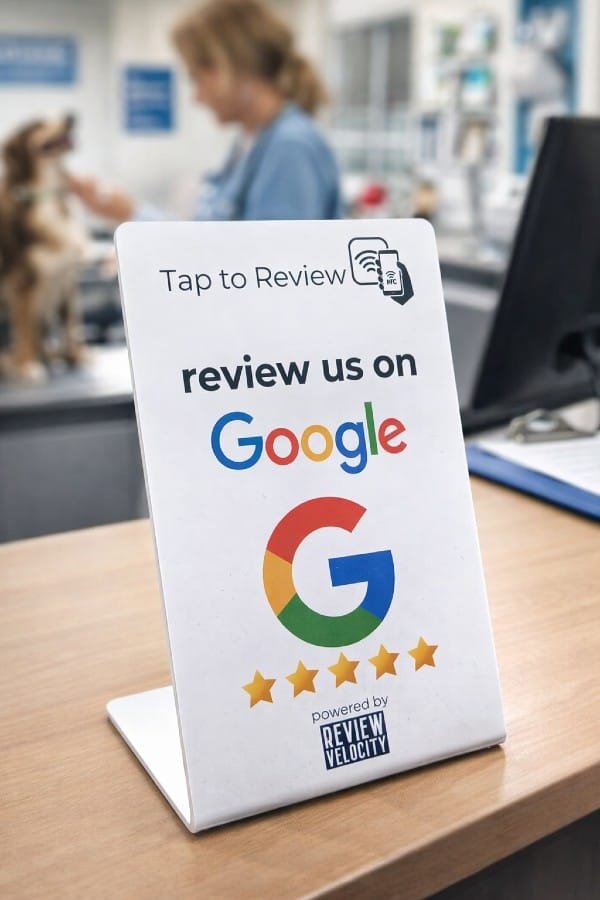
Picture two businesses on the same high street. One has a 4.9-star rating from 180 Google reviews, but its most recent review is from last spring. The other has a 4.6 from 70 reviews, and three new ones arrived this week.
Most owners would assume the 4.9 wins. More and more often, it doesn't.
The short answer
Review velocity is the pace at which a business earns new Google reviews: how many arrive each month, how recent the latest ones are, and how steadily they keep coming. Customers, Google and AI assistants all pay attention to how fresh your reviews are, not just your average score. A high rating built on old reviews is a fading asset. A steady flow of new reviews is a live one.
This article answers the questions owners ask us most about this: do old reviews still count, how many reviews you actually need, and why your star rating on its own no longer tells the full story. If you want the full definition and benchmarks first, read our guide to what review velocity actually means for your rankings.
Customers now check the date before the stars
When someone looks you up on Google, the first thing they see is your star rating. The second thing they do, increasingly, is scroll to see when the reviews were written.
BrightLocal's Local Consumer Review Survey 2026 puts numbers on this:
| What consumers said | 2026 |
|---|---|
| Look for reviews written in the last three months | 74% |
| Look for reviews from the last two weeks | 32% (up from 20% in 2025) |
| Rank "posted within the last month" among the most important review factors | 44% |
| Won't use a business with fewer than 20 reviews | 47% |
| Will only use a business rated 4.5 stars or higher | 31% (up from 17% in 2025) |
Source: BrightLocal Local Consumer Review Survey 2026, 1,002 US adults. UK-specific figures aren't published, but UK buyers use the same Google profiles in the same way.
Two things stand out. First, a third of people now want to see reviews from the last fortnight. If your newest review is six months old, those people move on before your rating comes into it. Second, standards are rising on both measures at once: customers expect a high rating and recent proof that it's still deserved.
A 4.9 from 2023 answers the question "was this business good?" A steady run of reviews from the last few weeks answers the question customers actually care about: "is it good now?"
Do old Google reviews expire?
No. Google doesn't delete reviews because of their age, and your older reviews still count towards your total and your average rating. They don't disappear.
What changes is how much they're worth. An old review still adds to your count, but it does nothing to show a customer, or Google, that you're active today. A profile where every review is a year old looks like a business that might have closed, changed hands or stopped trying. Customers notice, and as Google's own guidance below shows, it rewards businesses that look active and well known.
So the useful question isn't "do old reviews expire?" It's "what are my recent reviews saying about me?"
How Google uses reviews to rank local businesses
Google is open about the basics. Its guidance on local rankings says results are based on three things: relevance (how well your profile matches the search), distance (how close you are to the searcher) and prominence (how well known your business is). Reviews feed directly into prominence, and Google states plainly that "more reviews and positive ratings can help your business's local ranking."
Google doesn't publish an exact formula, and nobody outside Google can tell you precisely how much weight recency carries. What we do know:
- Review signals are gaining importance. The Whitespark Local Search Ranking Factors study, which surveys leading local SEO specialists, found reviews among the areas gaining the most weight in its 2026 edition.
- Recency is high on experts' lists. Local SEO specialists consistently rank review recency among the most important review factors, ahead of small differences in star rating.
- Your rating has a ceiling, your activity doesn't. Once you're above roughly 4.5 stars, a few tenths of a point make little difference to whether you're shown. A steady flow of new reviews keeps adding to your count, your freshness and the keywords customers use to describe you.
That last point matters more than most owners realise. Every new review is fresh text about your business, written by a real customer, often mentioning the exact service and location people are searching for: "boiler service in Maidstone", "emergency vet", "best Sunday roast". Old reviews say the same things about who you were. New reviews say them about who you are now.
Why AI search makes recency matter even more
Search is changing. Google's AI Overviews, the Gemini-powered Ask Maps feature in Google Maps, ChatGPT and other assistants increasingly answer questions like "Who's the best plumber near me?" directly, instead of showing ten blue links.
These tools summarise what's available about a business, and Google reviews are one of the richest sources of that. We covered how this works in Google Maps in Google Maps Ask Maps: why review velocity is now a local SEO essential.
This is still an emerging area and the exact mechanics aren't public. But the direction is clear: when an assistant is asked to recommend a business, recent, detailed reviews give it something current and specific to work with. A business with nothing new to say about it gives the assistant very little reason to mention it.
A worked example: 4.9 stars vs four new reviews a month
Here's an illustrative comparison of two businesses in the same trade and town:
| Business A | Business B | |
|---|---|---|
| Star rating | 4.9 | 4.6 |
| Total reviews | 180 | 70 |
| New reviews in the last 90 days | 1 | 12 |
| Most recent review | 5 months ago | 3 days ago |
On paper, Business A looks stronger. But think about what each one shows a customer who scrolls down:
- Business A shows a page of reviews from last year and the year before. The quality is clear, but there's no proof it's still true.
- Business B shows a dozen reviews from the last three months, with replies, mentioning recent jobs. It looks busy, trusted and current.
Business B is meeting what most customers now look for (recent reviews and a rating above 4.5), and it is adding fresh, relevant text to its profile every week. Business A is relying on its history. If Business B keeps its pace, it overtakes A on total reviews in under three years, and it looks more active than A every single month in between.
That's the core idea: your star rating is a snapshot, your review velocity is the trend. Customers, Google and AI tools all respond to the trend.
Steady beats spiky
If recency matters, it's tempting to run a big push: email every past customer, collect 40 reviews in a week, job done. It doesn't work well, for three reasons:
- It looks unnatural. A sudden burst followed by months of silence is exactly the pattern Google's spam systems are designed to scrutinise, and genuine reviews can get filtered along with it.
- It fades. Six months later you're back to a profile with no recent reviews, just a cluster of old ones.
- It's often where rules get broken. Under the UK's Digital Markets, Competition and Consumers Act 2024, the rules on fake reviews enforced by the CMA since 6 April 2025 ban fake reviews, hidden incentivised reviews and presenting reviews in a misleading way. Google also prohibits "review gating", where only happy customers are asked to leave a review.
What works is a review request built into your normal routine: every customer, every job, asked at the right moment, in the easiest way possible. That's how you get a few reviews a week, every week, without anyone having to remember to chase them.
How to find out your review velocity
You don't need special software to get a rough idea:
- Open your Google Business Profile and sort your reviews by Newest.
- Count how many reviews you've received in the last 90 days.
- Do the same for the three businesses that appear above you in Google Maps for your main service.
If they're earning reviews faster than you, they're building an advantage every month, whatever your current star ratings. If you're ahead, keeping that pace is what protects your position.
For a quicker comparison, our free review velocity checker shows how fast you're earning reviews against local competitors. If you want to see what a higher rating would take, the Google rating calculator works out how many five-star reviews you'd need.
Frequently asked questions
Is review velocity more important than star rating?
Both matter, but once a business is above about 4.5 stars, how recently and how often it earns new reviews usually makes more difference than small changes to the rating. Customers increasingly check review dates, and 74% look for reviews from the last three months.
Do old Google reviews stop counting?
No. Google doesn't delete reviews for being old, and they still count towards your total and average rating. But old reviews don't show customers or Google that your business is active now, so they lose influence over time.
How many Google reviews does a small business need?
There's no fixed number. BrightLocal found 47% of consumers won't use a business with fewer than 20 reviews, so that's a sensible minimum. Beyond that, aim to match or beat the monthly review pace of the businesses ranking above you locally.
How often should a business get new Google reviews?
Steadily, every month. A consistent flow of new reviews is better than occasional bursts, because a third of customers now look for reviews from the last two weeks and sudden spikes can look unnatural to Google.
Does Google penalise businesses for getting lots of reviews at once?
Google doesn't publish its rules, but unnatural bursts can trigger its spam filters, which may hold back or remove reviews, including genuine ones. Fake or hidden incentivised reviews are also illegal in the UK under the DMCC Act 2024.
The bottom line
Your star rating tells people how good you were. Your review velocity tells them how good you are now, and that's the question customers, Google and AI assistants are all trying to answer.
The good news is that this is one of the few areas of local marketing where small businesses can beat bigger competitors simply by being consistent. You don't need a bigger budget. You need a reliable way to ask every happy customer, every time.
See where you stand.
Review Velocity automates review requests by WhatsApp, SMS, email and tap-to-review stands, so new reviews keep arriving without anyone having to chase them. Check your review velocity for free or start a 14-day free trial, with no card needed.